License
MIT — permissive for most products
License · Libraries.ioSame topic — health-ranked peers. Open the matrix or jump to curves only.
Coding agent for DeepSeek models that runs in your terminal
Summary verifiedOne-line summary from the repository description on GitHub
The terminal coding agent for any model — open models first.
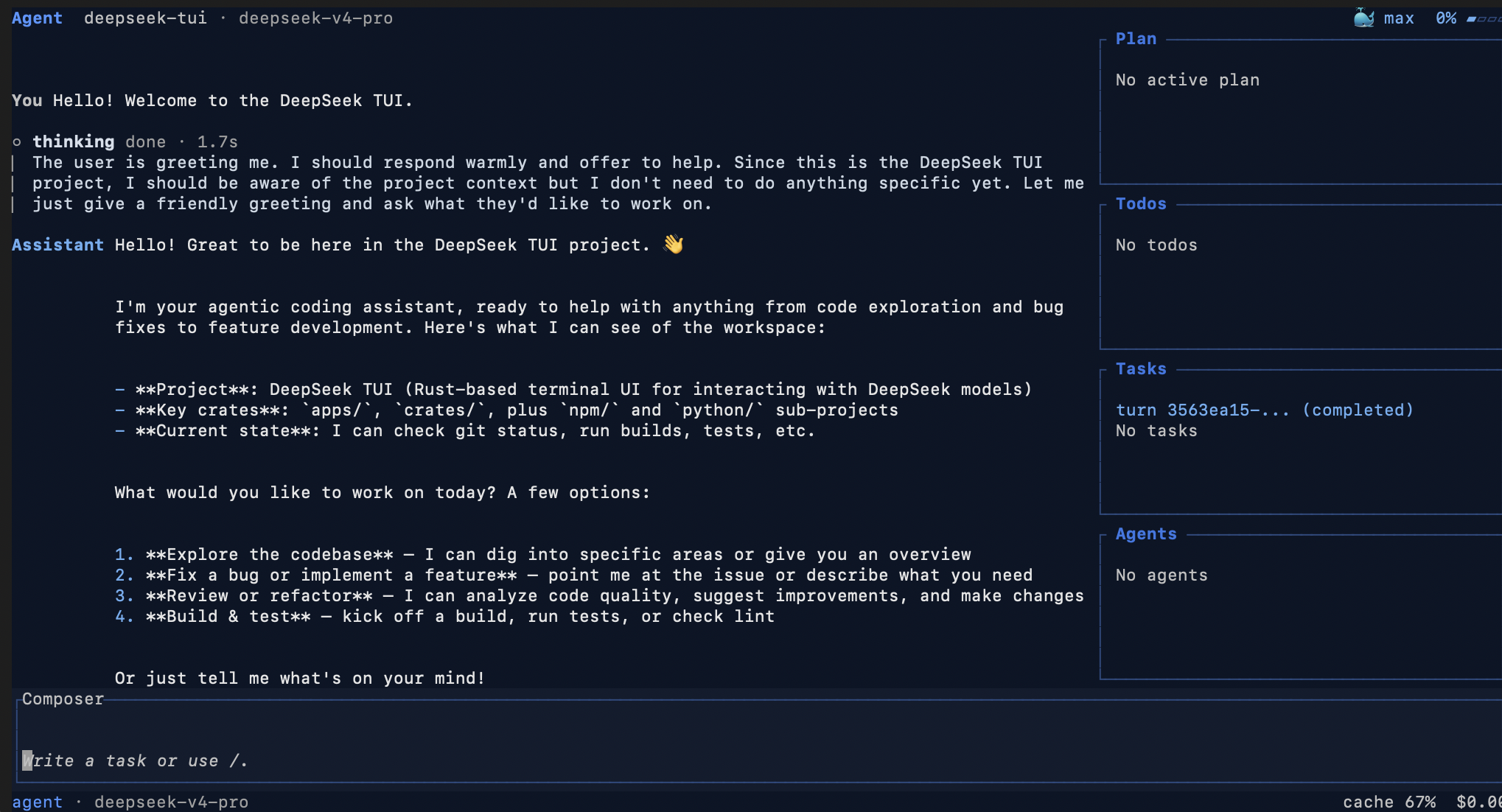
CodeWhale is a terminal coding agent — a TUI and a CLI. You point it at a model and a project, and it gets to work: reading code, making edits, running commands, checking results, planning multi-step tasks, and correcting itself when something fails.
It's open source (MIT, Rust), it runs on your machine, and it works with the models people actually use. DeepSeek and open-weight models are first-class, and a local vLLM/SGLang/Ollama box on your LAN needs no key at all — but Claude, GPT, Kimi, and GLM are full peers through the same runtime and the same tools. You pick a provider and a model; CodeWhale resolves a real route and runs.
The project began as deepseek-tui, a coding harness built around DeepSeek
workflows. The developer community — much of it in China — adopted it, filed
reports, and contributed fixes, and it became clear the harness was bigger than
one model. Multi-provider support followed, and the project became CodeWhale to
match. If there's a model, endpoint, or feature you don't see that you want,
open an issue — that's how the project grows.
简体中文 README · 日本語 README · Tiếng Việt README · 한국어 README · codewhale.net · · ·
MIT — permissive for most products
License · Libraries.ioNo known critical CVE in default branch scan
Full report on OSS Insight1287 commits / 30d · last push 54 days ago
Bus factor: healthy (active maintenance)




npm install -g codewhale
codewhale --version   # 0.8.68
The npm wrapper (Node 18+) downloads SHA-256-verified binaries from GitHub
Releases and installs codewhale, codew, and codewhale-tui. Prefer building
from source? Use cargo (Rust 1.88+):
cargo install codewhale-cli --locked
cargo install codewhale-tui --locked
Linux users: install system build dependencies first:
sudo apt-get install -y build-essential pkg-config libdbus-1-dev. See INSTALL.md.
Every other path:
# Docker
docker pull ghcr.io/hmbown/codewhale:latest

# Nix
nix run github:Hmbown/CodeWhale

# Windows
scoop install codewhale        # or the NSIS installer from GitHub Releases

# CNB mirror for users who cannot reliably reach GitHub
cargo install --git https://cnb.cool/codewhale.net/codewhale --tag v0.8.68 codewhale-cli --locked --force
cargo install --git https://cnb.cool/codewhale.net/codewhale --tag v0.8.68 codewhale-tui --locked --force

# Legacy Homebrew compatibility while the formula is renamed
brew tap Hmbown/deepseek-tui
brew install deepseek-tui
Prebuilt archives for Linux x64/arm64, macOS x64/arm64, and Windows x64 are attached to GitHub Releases. Android / Termux is a separate Android arm64 target, not the Linux arm64 asset. Linux riscv64 prebuilts are temporarily paused while upstream QuickJS bindings catch up. Checksums, Termux notes, China mirrors, Windows specifics, and troubleshooting live in docs/INSTALL.md.
Upgrading from the legacy deepseek-tui package? Your config, sessions,
skills, and MCP settings are preserved. See docs/REBRAND.md,
then run codewhale doctor to confirm.
codewhale auth set --provider deepseek
codewhale auth status
codewhale doctor
codewhale
Every provider is the same one-line shape: --provider openrouter,
--provider moonshot, --provider openmodel, or point vllm, sglang, or ollama at your own
localhost runtime with no key at all. Have a Claude key instead? Run
codewhale auth set --provider anthropic — or just export
ANTHROPIC_API_KEY — and the native Messages adapter takes it from there.
Keys land in ~/.codewhale/config.toml; legacy ~/.deepseek/ config is still
read for compatibility.
Useful in-session commands:
/provider opens the readiness dashboard — per provider it shows auth state,
the resolved default route, and the cost/usage meter. /model picks the model
and reasoning effort. Both also take arguments (/provider nvidia-nim,
/model auto) to switch mid-session./restore rolls back a prior turn from side-git snapshots./fleet opens the Fleet setup view — roles, profiles, loadouts, and policy./skills loads reusable workflows from ~/.codewhale/skills/./config edits runtime settings; /statusline chooses which footer chips
show route, cost, and session state.! cargo test -p codewhale-tui runs any shell command through the normal
approval and sandbox path.Headless, for scripts and CI:
codewhale exec --allowed-tools read_file,exec_shell --max-turns 10 "fix the failing test"
You pick a provider and a model, and CodeWhale resolves a real route — a
concrete endpoint, wire protocol, model ID, context limit, and price — instead
of just swapping a base URL. A RouteResolver is the only thing that can mint a
resolved route, so the same selection logic backs the TUI picker, the CLI, and
headless runs. The catalog behind it is a committed, network-free snapshot in
the Models.dev shape, optionally refreshed from a provider's live /models
endpoint.
Because the route is resolved, the rest of the harness can be honest about it:
Switch the route mid-session with /provider and /model. The full registry —
credentials, base URLs, capability boundaries — lives in
docs/PROVIDERS.md.
Every provider routes through the same runtime and the same tools. If the one you want isn't here, that's a good issue to open.
deepseek (the default), openrouter,
huggingface (Inference Providers), moonshot (Kimi), zai (GLM),
minimax, volcengine (Ark), nvidia-nim, together, fireworks,
novita, siliconflow / siliconflow-CN, arcee, xiaomi-mimo,
openmodel, deepinfra, stepfun, atlascloud, qianfan, wanjie-ark, plus a generic
openai-compatible route for any gateway.vllm, sglang, and ollama against your own
localhost endpoints — no key required.anthropic through a dedicated
/v1/messages adapter with adaptive thinking, prompt-cache breakpoints, and
signed-thinking replay; deepseek-anthropic, DeepSeek's opt-in Messages-API
route; and openai-codex (experimental), which reuses an existing
ChatGPT/Codex CLI login instead of an API key.Fleet is CodeWhale's durable control plane for multi-worker runs. A fleet worker
is a headless codewhale exec run, but the fleet launches and tracks it durably:
work is recorded in an append-only ledger (.codewhale/fleet.jsonl), so a run
survives a manager exit, laptop sleep, or a runtime restart.
codewhale fleet run tasks.json --max-workers 4
codewhale fleet status
codewhale fleet resume <run-id>
fleet resume replays the ledger, reconciles any in-flight task whose worker
stopped heartbeating (retrying within budget, else failing and escalating), and
is idempotent — safe to run after anything that interrupted the manager. Each
worker records a typed receipt (pass / fail / partial / skip /
timeout) so fleet status can report what actually happened.
Workers are shaped by roles, profiles, loadouts, and slots,
configured under [fleet] in your config or authored from the in-app Fleet
setup view. Loadouts express model intent as a class — strong, balanced, or
fast — and the route resolver turns that into a concrete provider/model. This
is the same headless runtime that backs in-session sub-agents; Fleet is the
durable layer on top. See docs/FLEET.md.
Workflow is the resumable, inspectable layer for larger jobs. It plans a goal
into bounded steps, can fan those steps out through Fleet workers, and records
progress and verification in .codewhale/workflow-runs.jsonl:
codewhale workflow run my-workflow.js --fleet <fleet-name> --runtime tmux --verify
codewhale lane status <lane-id>
codewhale lane logs <lane-id>
Workflow is an overlay, not another permission mode: Plan / Act / Operate and the Ask / Auto-Review / Full Access posture stay orthogonal to orchestration.
CodeWhale edits files and runs commands, so the safety posture is part of the product, not an afterthought.
Tab or /mode.
Shift+Tab independently cycles Ask, Auto-Review, and Full Access approval
posture; legacy YOLO remains a compatibility alias for Act + Full Access..codewhale/hooks.toml hook system can allow,
deny, or ask before any tool call, and the exec policy decides whether a
command runs, needs approval, or is forbidden outright..git, so
/restore can undo a turn without ever touching your real history./goal and the agent keeps
working across turns — reading, editing, running, checking results — until the
goal is done, it's blocked, or you stop it. No turn cap. /task tracks
background tasks; the Work sidebar shows live plan and checklist state.codewhale exec with --allowed-tools,
--disallowed-tools (deny wins), --max-turns, and --append-system-prompt
for scripts and CI.codewhale mcp.~/.codewhale/skills/, loaded with
/skills.Prefer a graphical IDE experience over the terminal? CodeWhale for VS Code is a community-maintained GUI frontend that wraps the same CodeWhale engine into a native VS Code sidebar — chat, slash commands, threaded conversations, live diffs, task management, and a settings UI, all without leaving the editor.
The GUI talks to the same local codewhale runtime over the Runtime API, so sessions, providers, modes, and skills stay in sync between terminal and IDE. If you live in VS Code, give it a try:
npm install -g codewhale        # install the engine first
# then search "CodeWhale" in the VS Code extensions panel
The minimal scaffold under
extensions/vscode/in this repo is a separate, read-only Phase 0 viewer. For the full chat experience, use the linked GUI project above.
As a project evolves, the instructions pile up and they inevitably conflict: the original spec, a later refactor that contradicts it, stale memory, a previous agent's handoff, your current request, and fresh test output that doesn't match what the handoff claimed. A flat system prompt makes the model resolve that by guess. CodeWhale uses a nested constitution so there's a defined rank instead of vibes.
The system prompt is layered, most-static first, and the order is enforced in code (there are tests asserting it can't drift):
/constitution and
/setup, saved as structured data under $CODEWHALE_HOME/constitution.json,
and rendered into a separate model-facing prose block. It is normal guided
setup output, not a raw prompt editor..codewhale/constitution.json in a repo to
declare protected_invariants, branch_policy, verification_policy, and
escalate_when. It's loaded as its own repo-local authority block, above
project instructions, memory, and handoffs. A protected_invariants entry
that carries path globs is not just prose: it compiles into a mechanical,
tighten-only write hold in the tool gate (ask force-prompts even in YOLO,
block denies) with a receipt naming the invariant. See
Configuration.AGENTS.md and compatibility fallbacks explain
how agents should work in this repo.Your current request and live tool evidence still control the active turn: the model may be given many layers, but it may never report a fact that the tools did not return. Runtime approval, sandbox, network, and trust controls are enforced in code and are not changed by constitution text.
There is also an expert-only full base-prompt override at
$CODEWHALE_HOME/prompts/constitution.md behind an explicit opt-in flag. It is
not the normal guided setup path. When two instructions conflict, each yields to
the higher authority layer. Because the law lives in the harness, not the model,
swapping models keeps the structure intact.
The README is the short version. The rest is in docs and on codewhale.net:
CodeWhale started as one person's DeepSeek side project. Developers from
countries all over the world have made it what it is — the contributor list on
every release is the proof. The project is built in the open, issues are triaged
in the open, and releases cut from main.
Something I learned early in teaching: all feedback is a gift. Issues, PRs, bug reports, feature ideas, "first PR"s, and curious questions all count as real project work. Maintainers treat every report as a contribution even when the final patch has to be narrowed, delayed, or folded into a maintainer commit — and recurring contributors stay credited in the public record. If you hit something that doesn't work, or you want a model that isn't listed, that's the most useful thing you can tell the project.
Support: Buy me a coffee.
CodeWhale exists because of the people who use it, break it, and fix it.
CodeWhale is an independent community project and is not affiliated with any model provider.
